I can speak, but I can’t type. I can hear, but I can’t see. I can see, but not very well. I can perform tasks like anyone, but I need some adaptations.
We have students, and adults for that matter, that experience those things above every day. Life isn’t always the easiest to navigate on a daily basis if you have a learning disability. A lot has changed in the recognition of what constitutes as disability. The definition of a disability itself has changed in recent times. The changes, as referenced in the article, The Broadening Definition of Disability, are as follows:
“Congress passed the ADA Amendments Act in 2008, which broadened the definition of disability to include any condition that limits an individual from performing a major life activity. Normal cell growth, for example, was included as a major life activity, and, similarly, having a history of a disability would also land an individual under the ADA’s protection. Both features of the law are important to cancer patients and survivors.
...the new definition of disability — which includes conditions such as cancer, epilepsy, diabetes and mental disabilities — went into effect in 2009…”
Students, and adults, want to succeed. It is our job as educators to make sure this happens. We are bound to put learners in the least restrictive environment. The U.S. Individuals with Disabilities Education Act defines the concept of the Least Restrictive Environment as the opportunity for a student with a disability to be "provided with supplementary aids and services necessary to achieve educational goals if placed in a setting with non-disabled peers." (Daniel R.r. v. State Bd. of Educ., 874 F.2d 1036, 1050, 5th Cir.1989)
“Assistive technologies are helping to bridge the gap for learning disabled students. AT can address many types of learning difficulties. A student who has difficulty writing can compose a school report by dictating it and having it converted to text by special software. A child who struggles with math can use a hand-held calculator to keep score while playing a game with a friend. And a teenager with dyslexia may benefit from AT that will read aloud his employer's online training manual.”
Technology isn’t always the answer, but if it can make life better...let’s use it! In the world of technological advances, more and more learning disabled people are overcoming boundaries. It is our job as educators to find those technologies, and bring them to those that need it.
I think this best sums up what need to strive for, to help those that are learning disabled:
Differentiation,
inquiry-based instruction, personalization, flipped classroom, gamification and
grit are among the top education buzz words for 2015. Some sound kind of scary,
like grit while others sound warm and fuzzy like personalization. Most of these
buzz words are also intertwined into different buzzwords that describe many educational
trends occurring at once. Out of the words mentioned above, only a few consists
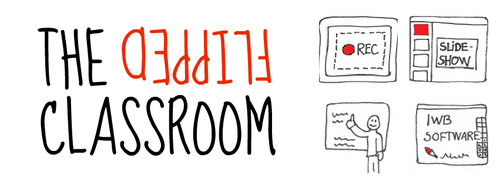
of a technology backbone. Flipped classroom is one of these technology-rooted
buzz words. Exactly what is a flipped classroom? How is this buzz word being perceived
by bloggers and blog commenters?
According
to Horn and Staker (1) a flipped classroom is a type of rotational model within
the blended learning framework. The flipped classroom is “so named because it
flips the typical function of the classroom on its head. In a classroom that’s
flipped students consume online lessons or lectures independently, whether at
home or during a homework period on campus. Time in the classroom, previously
reserved for teacher instruction, is instead spent on what we used to call
homework, with teachers providing assistance as needed”.
They
claim that this model can improve student learning in the following ways;
·Allowing students to go through lecture material
at their own pace, making the content more personalized. Students who need to
review may do so at their discretion and students who excel can skip material
in which they are proficient.
·Time with the teacher is more student-centered
and focused on the creation of projects, discussing issues, practicing the
content and applying their knowledge. This ensures the teacher is present while
students go through the trial and error period of testing their understanding.
I’m sure you’ve already filled
your brain with a few questions and possible pitfalls. You are not alone. A
quick Google search for “flipped classroom” will return a few blogs that
highlight the pros and cons of
flipped classrooms. And some of those blogs are rich with comments either
defending flipped classroom models, or comments asking questions and challenging
the reality of a flipped classroom.
One user commenting on the
Education Next article (2) with “If every class uses this method,
students receive twice as much instruction in the course of a week as they
would by simply attending school–the obligatory hour per class in school and an
additional hour per class outside of school to learn the material (plus their usual
homework?)”. Another, on Schools of Thought (3) “It would be interesting to
know exactly how much content is expected to be watched/researched/absorbed in
an evening, so for a child in 5 classes (Math, English, Science, Social
Studies, Elective/Language/etc.) – how much home learning would be required?”
At first these comments doesn’t make much sense. Most
of the literature on flipped classroom pretty clearly states that teachers
should be careful when assigning more work than what can be reasonably
completed both during class and outside of school. According to the Flipped Classroom Field Guide (4) “To avoid overworking your
students, try reducing their homework by focusing your learning goals and
trimming unnecessary content. If you are converting a dense, traditional
lecture to a flipped class, take this opportunity to remove content that only
tests student recall and does not further you’re learning goals. Instructors
could also try reducing class time to compensate for the increased amount of
out-of-class work.”
Further thought about the user’s comment regarding extra work and
out of school time required by students raises the question of scheduling. How
exactly do you schedule a flipped classroom? Most of us are used to a more
traditional schedule with 40-60 minute classes. Others are blessed with block
scheduling. Both can be “flipped”, with block scheduling being a little more
workable as is that a traditional period schedule.
Most sources refrain
from suggesting a schedule for flipped classrooms. They claim that flipped
classrooms are not one size fits all, and therefore there is no correct set-up
or schedule. However, an EdTech (5) article mentions the almost seamless
flipping of a block schedule classroom. “An advantage of Block
Scheduling is the additional class-time available for group assignments and
collaborative projects that serve to reinforce learning and improve critical
thinking skills, particularly evaluation and creativity.”
With a block schedule there is “work
time” immediately following “lecture time” (assuming the teacher doesn’t blab
the entire block). Students easily transfer the concepts without feeling a
disconnection between what is covered in lecture and what is done during
work/project time. Also, Edtech hints at one important fact, not all flipped
classrooms require outside of class work. Some classes, especially those with
block schedules, are able to give the students time to work through lecture
materials and then transition to the work period (where a project, discussion
or practice takes place) all while in the brick and mortar classroom!
Others see flipping as a scapegoat for teachers. Robinson Meyer from the Atlantic (6) wrote about study findings relating to improved student achievement in a flipped setting. Commenters were split on the findings and questioned if flipping was really in the best interest of the students;
“James_Blair•2 years ago
Wonderful.
We have somehow discovered that the old methods of the diplomia mills and
correspondence schools are "better" at teaching students than
traditional college courses. American higher eduction is headed for ruin. You
people are insane.
Good artists borrow, great artists steal. This is one maxim both
Robin Thicke and Pharaell Williams tried to dispute last spring while
testifying their “Blurred Lines” hit did not draw from Marvin Gaye’s 1977 hit
“Got to Give it Up”. This is not the first and will not be the last case
involving artists and copyright. If you peruse the comments on any articles
related to Thicke and William’s case, you will find a mix of opinions. Some
believe the guilty verdict was justified and sets a precedent for other
artists. Others believe it was unwarranted, harsh and at the least, an
opportunity to stifle creativity.
How did the court come to their decision regarding the “Blurred
Lines” case? First, compelling evidence from Williams was considered. Williams
admitted he drew on Gaye’s style and that he looked up to him from a young age.
Second, the judge and jury considered the existing copyright laws and evaluated
“Blurred Lines”.
What criteria was used to decide that “Blurred Lines” did
infringe copyright? Copyright laws focus on four main areas;
·“the purpose and character of the
use, including whether such use is of a commercial nature or is for nonprofit
educational purposes,
·the nature of the copyrighted work, the
amount and substantially of the portion used in relation to the copyrighted
work as a whole and
·the effect of the use upon the
potential market for or value of the copyrighted work."(1)
The first criteria copyright law addresses is use related to
educational purposes. Clearly, “Blurred Lines” does not provide any educational
value, so Fair Use is out of the question. However, this portion of the law
applies directly to teachers. So where does the use of YouTube, some teacher’s
main resource, fall on the copyright spectrum? What about downloading those
videos for use on a Learning Management system? How about showing purchased
media to a classroom of students?
The American Library Association (2) quotes the Copyright Act of 1976 with "Public performances of a video/DVD in the face-to face classroom is an exception to the public performance right §110 and therefore lawful. The following conditions apply:
The teaching activities are conducted by a non-profit education
institution
The performance is in connection with face-to-face teaching
activities.
The performance takes place in a classroom or similar place devoted
to instruction.
The person responsible for the performance has no reason to believe
that the videotape was unlawfully made.”
Educators are covered when showing
YouTube videos to their class, but the bullet regarding the performance taking
place in a classroom or similar place raises questions about blended learning.
Blended learning, defined by Horn & Staker (3), “is a formal education
program in which a student learns at least in part through online learning with
some element of student control over time, place, path and/or pace and at least
in part at a supervised brick-and mortar location away from home”. If it is truly
blended learning then all videos shown should be covered under the above
conditions. However, fully online education falls into more of a gray area
where the conditions are not clear.
If educators are using digital media,
mainly videos, within their curriculum, it is safe to assume these videos will
be placed on some type of learning management system. Especially if the
curriculum is being presented in a blended format. Does linking YouTube videos
from a learning management system infringe copyright? According to the library
site for the University of Missouri-Kansas City (4), the best way to handle
YouTube videos [on learning management systems] is to link the video.
But what if school filters prevent
your students from accessing YouTube? This is the case for my classroom, where
downloading YouTube videos is really the only alternative to showing the video
to the entire class at once. Most YouTube videos, including my favorites from
TedEd and Crash Course Biology (Khan Academy), have a standard license. The
standard license issues YouTube the rights to broadcast the uploaded content,
but all other copyrights remain in tack.
YouTube’s terms of service (5)
directly state “Content is provided to you AS IS. You
may access Content for your information and personal use solely as intended
through the provided functionality of the Service and as permitted under these
Terms of Service. You shall not download any Content unless you see a
“download” or similar link displayed by YouTube on the Service for that
Content. You shall not copy, reproduce, distribute, transmit, broadcast,
display, sell, license, or otherwise exploit any Content for any other purposes
without the prior written consent of YouTube or the respective licensors of the
Content.”
Overall educators are granted more freedom when it comes to
copyright laws, provided we are accessing and using the material for
educational purposes. However, if we are dabbling in a side career as a
pop-star, we should keep in mind the consequences suffered by Thicke and
Williams. As an educator, I hope teachers continue to find and use digital
media resources as there is much to be gained when presenting content through
unique and engaging materials. A teacher’s battle might be more so against
their own district’s policies on student filters and access rather than YouTube
copyright infringement!
(2) "Video
and Copyright." American Library Association. N.p., n.d. Web. 20
Jan. 2016.
<http://www.ala.org/tools/libfactsheets/alalibraryfactsheet07>.
(3) Horn,
Michael B., and Heather Staker. "Chapter 1." Blended: Using
Disruptive Innovation to Improve Schools. San Francisco: Jossey-Bass, 2015.
N. pag. Print.
(4) "Copyright
Tags: Copyright ." Media in the Classroom.
University of Missouri-Kansas City, n.d. Web. 20 Jan. 2016.
<http://libguides.library.umkc.edu/content.php?pid=31006&sid=794429>.
Being replaced by technology has been on the human mind starting in the mid
1990's (check out The End of Work by J. Rifkin, 1996) and
still going strong today (Machines will eventually take on every
job- BBC 2015). With the increase of technology use in classroom
over the last 5 years, teachers are shaking in their boots right along with
truck drivers, waitresses and customer service representatives.
Could it really happen?
If teachers and administrators keep shoving as much technology into the
classroom and school curriculum as possible, without stepping back to answer
"why are we using this technology", then yes, technology will replace
teachers.
Making content more
accessible through learning management systems and digital media. Allowing
students to use the same technology they constantly choose to be on during
their free-time. Opening up doors to experiences lost without a virtual
connection or component. These are the positive reasons for technology use in
the classroom and surely this is what everyone has in mind when they put
technology into student's hands.
Most of the time, the
technology is made available before teachers, and students, really know why
they are being asked (or told) to use it in the first place. This is all
backwards. Before curriculum changes are made, before apps and digital content
are explored and most certainly before new technology is purchased, schools and
teachers need to be asking "why are we using this specific technology?
How will it facilitate learning? How will it be more successful in growing
students and helping them achieve more than the strategies we are already implementing?”
Out of the plethora of
resources in the "future land", only a few even mentioned different
teaching styles/educational framework instead of focusing solely on the newest gadget, app or way to
present content (mobile learning!). Out of the articles that did hint at
teaching strategies and approaches, I was a bit disappointed to see their
predictions. While they do not boost these predictions as the right course of
action, we all know many teachers, administrators and non-educators, will job
on board to make sure they are implementing the latest and greatest.
One article, Top 9 e-learning predictions for 2014,
mentioned "Gamification" and "Video based learning".
Hopefully they mean "Game-based learning" and not Gamification. If
you are not sure of the difference, check out this Video
Presentation. The Journal, which aims at "transforming
education through technology" (10 major tech trends in education)
lists access to personal mobile devices as #1 with using a mobile device for
homework as #4. Message received. Because kids are on their cell phones 24/7,
making content mobile accessible will make them love to learn! Or will it?
Another, The Future: What 32 Ed Leaders are
Excited About, was a little more on track. The article quotes Jessie
Woolley who says "Digitized versions of a textbook or worksheet does not
produce a personalized experience" and Elaine Berndes with "Teaching
kids how to do life" is what excites her.
Lastly, Launching the Workshop really
hit the nail on the head. Even though "the Workshop" is an entirely
redesigned school, their philosophies and core ideas can be applied to all
classroom settings. Using technology to create online portfolios of student
work, to differentiate within subject areas, provide additional support to
students, and to facilitate productivity and collaboration.
Grouping all of these
articles together can be misleading. Some are just attempting to comment on the
newest technology trend, while others are trying to tackle the big problems
within our educational system. The real problem is that many people do lump
these two topics together and believe that technology can solve the educational
epidemic we are facing.
1. Kids are bored and
technology will provide better ways to engage students.
2. More data-based
adaptive technologies will lead to child-centered curricula.
3. Video games will
finally contextualize academic content.
4. Learning should be
more fun
Next time you plan a
lesson, or go to revise curricula, really ask, "why this specific technology?"
If the answer is "It will make the content more engaging.", "We
will have access to more data on student achievement.", "Kids are
already on their phones 24/7, why not use them for content?", then dig a
little bit deeper. Technology is not a Band-Aid for bored kids and budget cuts.
It is not more than a tool to personalize
learning and provide blended learning opportunities.
Technology will not
bring an end to the teaching profession if it is used to change the way
education is framed. Technology will help students become passionate about
learning. Technology will make the classroom more
personal, not less. It will leave teachers and students more time for collaboration and innovation (Why The Future Of Technology Is All Too Human). More thought into the "why are we using technology?" question more than the "which technology are we using" question will ensure technology is the tool that facilitates students becoming high achievers in life, not just in the classroom.
Tuesday, January 12, 2016
Blogs posts are worth 30 XP!
Guidelines:
Reflect on readings/learning in an LTMS 510 land
Relate and share a learning technology resource
Ask questions based on a learning theory scenario
Be sure the blog post content is clearly connected to the selected learning theory land.
Reply to comments on your blog post for an ongoing discussion when appropriate
Create a discussion in the Moodle forum to receive XP for your blog post.
The
subject of the Moodle forum discussion should include one of the lands of learning
theories for which you created a blog post (e.g. "Management Systems"), as
well as the title of your blog post
The body of the discussion should include a link to your blog post from this blog site.
Full
XP will be given to blog posts that are well written, clear and
concise. Blog posts should also be reflective and approach a subject
from a unique perspective in order to receive full XP.